


Data Engineering Articles
Data Engineering Projects: How to Build Real-time Streaming Data Pipelines
What is the Difference between Data Science and Data Engineering?


Get In Touch For Details! Request More Information

10 Useful Tips To Build Your Professional Data Engineer Resume
Dec 01, 2023 3 Min Read 116 Views
(Last Updated)
Notice: Undefined offset: 0 in /var/www/html/wordpress/wp-content/themes/guvi-blog/functions.php on line 148
Notice: Trying to get property 'horizontal' of non-object in /var/www/html/wordpress/wp-content/themes/guvi-blog/functions.php on line 148
Data Engineering is one of the booming fields in this current digital era and it is important for you to stay ahead of the crowd. What sets you apart is your data engineer resume. The more creative and the more diverse it is, the more your chances of attracting your employer.
Creating a compelling data engineer resume is crucial to showcase your skills, experience, and achievements in the field. Your resume should speak for yourself. So, it is important for you to add in all your skills, projects, and work that are related to data engineering.
In this article, you will understand how to make a professional data engineer resume that can take you places and help you get your dream job. So, without skipping, read this article through to the end and learn about building a professional data engineer resume.
Table of contents
- Building a Professional Data Engineer Resume
- Contact Information
- Summary/Objective
- Skills
- Professional Experience
- Project Highlights
- Education
- Certifications
- Technical Projects
- Publications or Presentations
- Languages and Tools
- Example of a Professional Data Engineer Resume
- Conclusion
- FAQ
- What is the role of a Data Engineer in a company?
- Which programming languages are commonly mentioned in a Data Engineering resume?
- How should I format my Data Engineering resume?
- How important is cloud computing in Data Engineering?
Building a Professional Data Engineer Resume
The scope of data engineering is high these days and over time, data engineering will get competitive and it is important for you to have a well-built data engineering resume prior to that.
It is important to remember that the more crisp and content-oriented your resume is, the better your chances of landing a great job. So, don’t add unnecessary information and make it long.
Now let us see the contents that need to be there on a data engineer resume.
1. Contact Information
At the top of your resume, include your full name, phone number, email address, and optionally, your LinkedIn profile. Make sure this information is current and easily accessible to recruiters.
2. Summary/Objective
Write a brief, impactful summary or objective statement that highlights your expertise, years of experience, and key skills as a data engineer. Tailor this section to match the specific job you’re applying for. Make sure to highlight your key strengths and career aspirations.
3. Skills
Create a dedicated section containing all the required skills for a data engineer. Technical skills may include proficiency in programming languages (Python, Java, etc.), database management systems (SQL, NoSQL), ETL tools, data modeling, and cloud platforms (AWS, Azure, Google Cloud). Soft skills may include problem-solving, teamwork, and communication.
4. Professional Experience
Detail your work history in reverse chronological order. For each position, include the company name, location, your job title, and the dates of employment. Provide a concise yet detailed description of your responsibilities, focusing on achievements and quantifiable results. Highlight any data engineering projects, ETL processes, or data pipelines you’ve developed or optimized.
5. Project Highlights
If you’ve worked on specific projects demonstrating your data engineering skills, create a separate section to showcase them. Describe the project scope, your roles and responsibilities as a data engineer, the technologies used, and the impact on the organization. Quantify your achievements whenever possible (e.g., “Reduced data processing time by 30%”).
6. Education
List your educational background, including the degree earned, the institution attended, graduation date, and any relevant academic achievements or honors. If you have a degree in a field related to data engineering or computer science, emphasize that.
7. Certifications
It is important for you to have professionally certified courses related to data engineering in your data engineer resume. This ensures that you are willing to learn the subject and learn things out of your syllabus.
You can also include certifications like AWS Certified Big Data – Specialty, and Google Cloud Professional Data Engineer, as these certifications help in validating your expertise in data engineering technologies.

8. Technical Projects
If you have personal or open-source projects that showcase your data engineering skills, provide details in a separate section. Include project names, descriptions, technologies used, and any notable outcomes.
9. Publications or Presentations
If applicable, include any articles, blog posts, or presentations you’ve authored related to data engineering. This demonstrates your thought leadership and ability to communicate complex concepts.
10. Languages and Tools
If there are specific programming languages, tools, or frameworks you’re proficient in, consider listing them separately. This could include languages like Python or Java, ETL tools like Apache NiFi or Apache Beam, and database systems like MySQL or MongoDB.
Make sure to tailor your resume for each job application, emphasizing the skills and experiences most relevant to the specific role you’re applying for. Keep it concise, use action verbs, and quantify your achievements wherever possible to make your resume stand out to potential employers.
Example of a Professional Data Engineer Resume
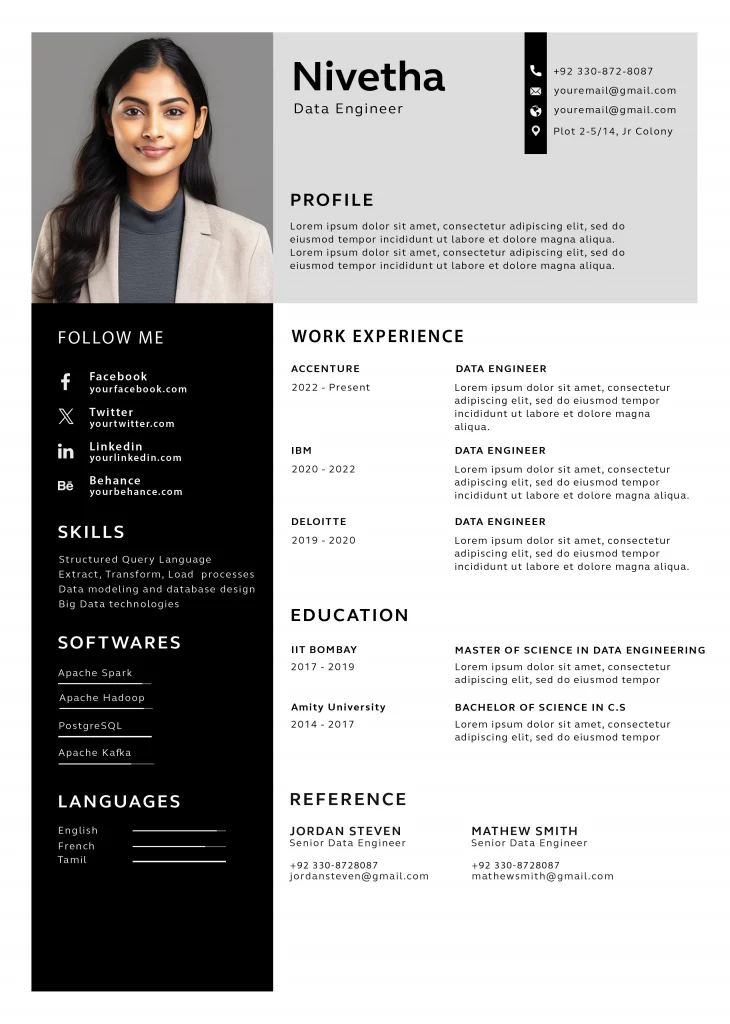
It is time for you to see a professional data engineer’s resume to understand the nuances and details that it holds. Here is one such type of data engineer resume:
Conclusion
In conclusion, building an effective data engineer resume is an essential step toward securing a rewarding and impactful job in the dynamic field of data engineering. A well-structured resume not only serves as a reflection of your skills and experiences but also as a powerful tool to capture the attention of prospective employers.
Remember to tailor your resume for each application, emphasizing the specific skills and experiences that align with the requirements of the desired position. With a thoughtfully built data engineer resume, you position yourself as a standout candidate ready to contribute to the ever-evolving landscape of data-driven innovation.
FAQ
What is the role of a Data Engineer in a company?
A data engineer is responsible for designing and maintaining the systems and architecture that allow for the efficient collection, storage, and retrieval of data to support the organization’s analytical and operational needs.
Which programming languages are commonly mentioned in a Data Engineering resume?
Commonly used programming languages in data engineering include Python, Java, Scala, and occasionally others depending on the specific tools and technologies in use.
How should I format my Data Engineering resume?
Format your data engineering resume with clear sections for contact information, summary, skills, professional experience, education, certifications, and any relevant projects or technical achievements.
How important is cloud computing in Data Engineering?
Cloud computing is crucial in data engineering as it provides scalable and cost-effective solutions for storing, processing, and analyzing large volumes of data. Familiarity with cloud platforms like AWS, Azure, or Google Cloud is highly valued.
Success Stories








Did you enjoy this article?